


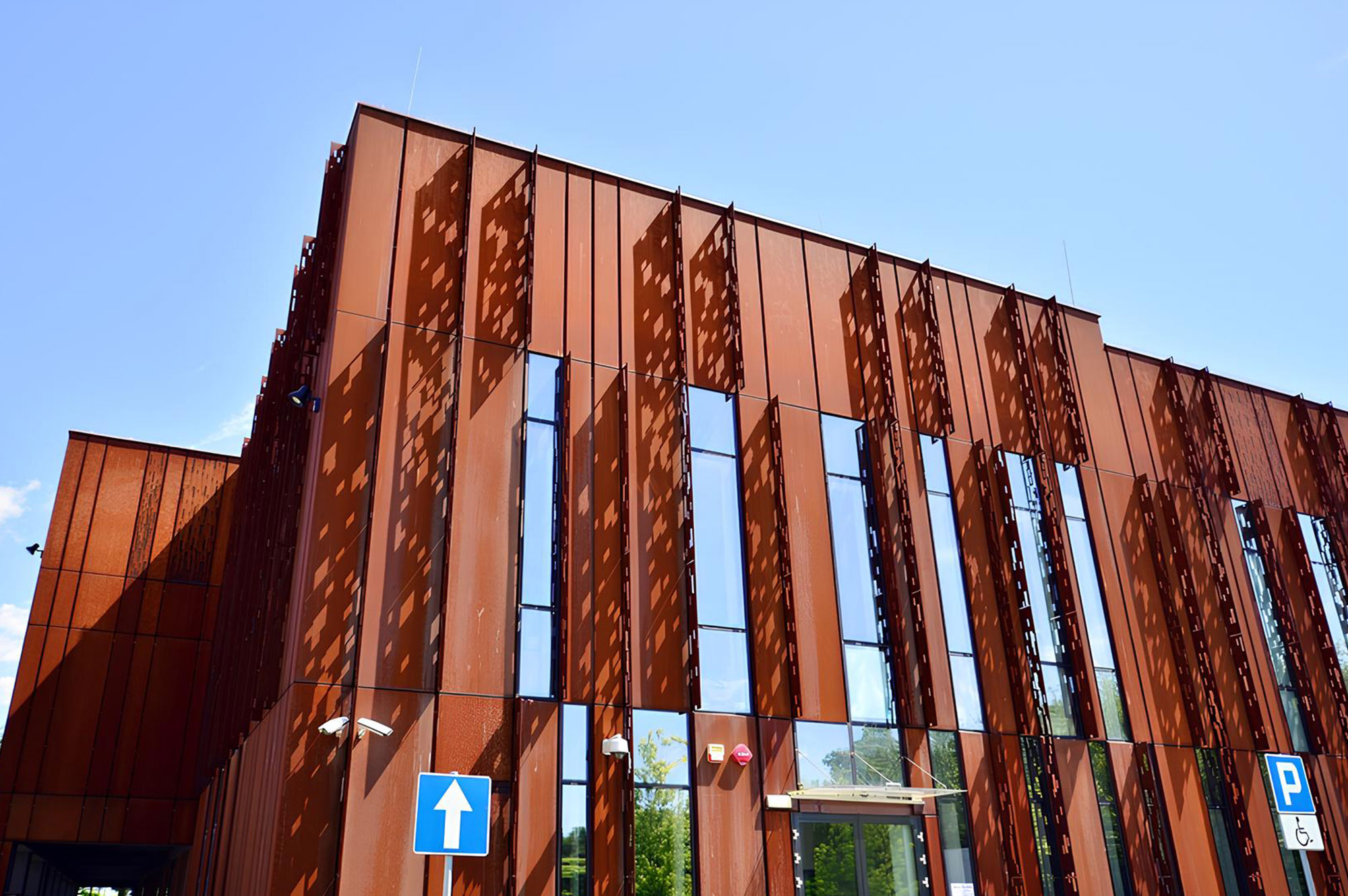
1. Overview of Weathering Steel
Weathering steel is a group of low-alloy steels with enhanced resistance to atmospheric corrosion thanks to specific alloying elements, typically copper (Cu), chromium (Cr), nickel (Ni), silicon (Si), and phosphorus (P). When exposed to the atmosphere, this steel forms a tightly adherent oxide layer known as patina, which significantly slows down the oxidation rate compared to conventional carbon steel.
This patina layer develops through natural wet–dry cycles and is the key reason why weathering steel requires less maintenance and offers longer service life in outdoor environments. However, this material requires suitable climatic conditions to perform effectively and may not be appropriate in continuously humid environments or areas with high salt content, such as coastal regions.
Although weathering steel standards vary worldwide in terms of minimum chemical composition, mechanical properties, and testing requirements, they all aim to achieve comparable atmospheric corrosion resistance. These steels are widely used in structural applications, bridges, and architectural façades.
2. Weathering Steel Standards and Grades by Country
Australia / Australia & New Zealand Standards
In Australia, weathering steel is specified under AS/NZS structural steel standards, including:
-
AS/NZS 3678:2016 – Hot-rolled structural steel, including weathering grades such as WR350A and WR350B, with L0/L20 variants indicating different phosphorus levels affecting corrosion resistance and weldability.
-
AS/NZS 1594:2002 & AS/NZS 1595:1998 – Standards for hot-rolled plates and cold-rolled coils of weathering steel.
-
AS/NZS 1554.1:2014 – Welding requirements for structural and weathering steels.
-
AS 4312:2019 – Atmospheric corrosion classification guidelines for designing weathering steel structures in Australia.
A notable commercial product is Redcor® weathering steel by BlueScope, available in:
-
Type A – Higher phosphorus content, suitable for architectural applications.
-
Type B – Lower phosphorus content, suitable for heavy load-bearing structures such as bridges.
These standards emphasize welding procedures, environmental suitability, and detailed design, fabrication, and maintenance requirements tailored to Australian and New Zealand climates.
Japan – JIS (Japanese Industrial Standards)
Japan defines weather-resistant steel under JIS G3125, including:
-
SPA-H and SPA-C – Weathering steel grades equivalent to Corten, commonly used in structural applications, railway cars, and containers.
Additionally, JIS G3114 specifies:
-
SMA400W / SMA490W / SMA570W – Grades designed for varying strength levels and corrosion resistance.
Japanese standards strictly define mechanical properties, chemical composition, and impact toughness, reflecting the country’s diverse climate, including cold regions and coastal exposure.
China – GB/T Standards
China specifies weathering steel mainly under GB/T 4171, covering:
-
Q235NH, Q355NH, Q460NH, Q550NH – Structural weathering steel grades with enhanced atmospheric corrosion resistance.
-
Q355GNH / Q295GNH – Higher-grade weathering steels with improved performance.
-
09CuPCrNi-A/B, railway standards, and Q/BQB 340 B460NQR, B480GNQR, for specialized engineering applications.
Chinese standards focus on tensile strength tolerances, elongation, and alloy composition, targeting atmospheric corrosion resistance comparable to international standards.
United States – ASTM / AISI Standards
The United States pioneered weathering steel standards, primarily under ASTM:
Standard spectral variables:
-
ASTM A588/A588M – Structural weathering steel with multiple grades (A, B, K)
-
ASTM A242 – Weathering steel plates for outdoor structural use.
-
ASTM A606 Type 4 – Weathering steel for thin sheets.
-
ASTM A871 / ASTM A709 Grade 50W – Additional grades for plates and structural members.
ASTM standards provide comprehensive guidance on design, testing, welding, fabrication, and erection, particularly for bridges and industrial structures. Weathering fasteners and bolts are also standardized.
Southeast Asia (ASEAN) – Standards & Application
ASEAN countries do not have a unified weathering steel standard. Most projects adopt international standards such as ASTM, JIS, EN, or GB.
The ASEAN Guidelines on Standards and Conformance (AG-STRACAP) aim to harmonize technical standards and promote mutual recognition among member countries, facilitating cross-border trade and application of international materials.
Due to the region’s high humidity and heavy rainfall, selecting appropriate weathering steel requires careful environmental assessment. International standards often specify wet–dry cycles, chloride exposure limits, and mechanical testing requirements to guide proper material selection.
3. Comparison of Weathering Steel Standards
| Country / Standard | Weathering Steel Grades | Key Notes |
|---|---|---|
| USA (ASTM) | A588 (A/B/K), A242, A606 Type 4, A871 | Structural, plate, and sheet applications |
| Europe (EN 10025-5) | S235J0W/S235J2W, S355J0WP/S355J2WP | Improved toughness, low-temperature performance |
| Japan (JIS) | SPA-H, SPA-C, SMA400W/ SMA490W | Structural and railway use |
| China (GB) | Q235NH, Q355NH, Q460NH, Q355GNH | Widely used, diverse grades |
| Australia/NZ (AS/NZS) | WR350A/B, CW300A, HW350A | Welding and corrosion zoning emphasized |
4. Applications & Technical Considerations
Applications
-
Bridges and infrastructure (frames, heavy load-bearing structures).
-
Outdoor structures such as architectural façades, retaining walls, and steel pipelines.
-
Railway facilities, containers, and transmission towers.
Technical Considerations
-
Weathering steel must be used in environments with clear wet–dry cycles for stable patina formation.
-
Not suitable for permanently humid or high-salinity coastal environments unless additional protection is applied.
-
Welding and installation must strictly follow relevant standards to preserve corrosion resistance.
5. Conclusion
Weathering steel is a long-term, cost-effective material solution for outdoor structures due to its self-forming protective oxide layer. While each country maintains its own standards (ASTM – USA, JIS – Japan, GB – China, AS/NZS – Australia), the grades are largely equivalent in performance, differing mainly in composition details and testing procedures. ASEAN countries typically adopt these international standards, promoting flexibility and consistency in material selection, design, fabrication, and construction of weathering steel structures.